Lesson #1: Sabbath
We begin our journey today not with an answer, but with a feeling. You know it well. It’s the feeling you get when you wake up and, before your feet even touch the floor, your hand is already reaching for your phone. It’s the vibration in your pocket that feels like a phantom limb. It’s the subtle, low-grade panic that sets in when the Wi-Fi goes down or the battery bar turns red.
We are living in the loudest moment in human history.
Look around. The world is screaming. Our screens flicker with an endless stream of “breaking news,” demanding our outrage. Our headphones pump podcasts, music, and voices into our ears from the moment we commute until we collapse into bed. We are the most connected generation that has ever walked the earth, yet every study tells us we are also the most anxious, the most lonely, and the most exhausted.
We are “unbundled”—fragmented into a thousand digital pieces, scattered across apps and notifications. And deep down, beneath the noise, a terrifying question is forming in our souls:
“Where can I find silence?”
For many of us, the answer is “nowhere.” And that is not an accident. It is a crisis. Today, we are going to talk about why the noise is killing us, and how an ancient practice called Sabbath might just be the rebellion we need to save our lives.
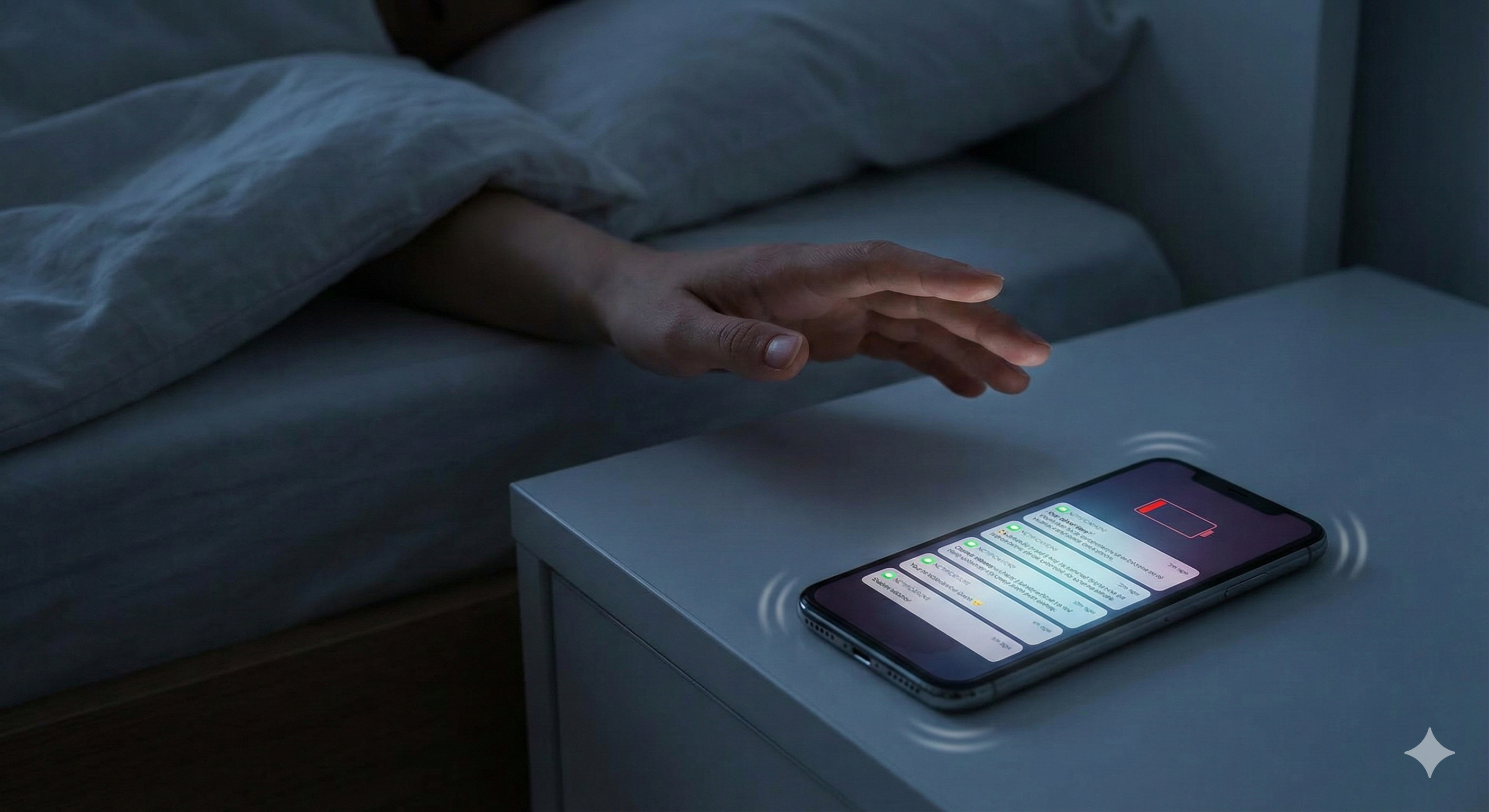
Our question for this week challenges our addiction to noise:
“Do you own your device, or does it own you?”
The Myth: “I Must Be ‘Always On’”
We operate under a powerful, unspoken myth. It’s a story the world tells us every day, and we believe it without question. The myth is this: “I must be ‘Always On’ to matter.”
This myth whispers to you constantly. It tells you that silence is empty. It tells you that if you are not producing, consuming, or communicating, you are wasting your life. It equates “busyness” with “importance.” It equates “connection” with “love.”
We believe that if we disconnect, even for an hour, we will disappear. We fear the “Fear of Missing Out” (FOMO) more than we fear the loss of our own souls. We treat silence like a void to be filled, a problem to be solved. If there is a lull in conversation, we panic and check our phones. If we are waiting in line at the grocery store for thirty seconds, we scroll.
We have become terrified of being alone with our own thoughts. We have bought the lie that our value comes from our visibility. If I am not seen, do I exist? If I don’t reply instantly, do I matter?
The Divine Answer: Sabbath
But there is another voice. It is older than the internet, older than the printing press, older than empires. It is the voice of God. And God offers a radically different perspective. The Divine Answer to the crisis of noise is Sabbath.
Now, you might hear the word “Sabbath” and think of a boring religious rule—a day where you can’t have fun. But that is not what Sabbath is. Sabbath is a spiritual resistance movement. It is an act of rebellion.
Consider the ancient story of the prophet Elijah found in the Hebrew scriptures (1 Kings 19). Elijah is a man who has done everything right. He has fought the battles, spoken the truth, and worked himself to the bone. And he is completely burnt out. He is terrified, exhausted, and running for his life. He collapses under a tree and asks to die. He has nothing left to give.
God does not send him a “To-Do” list. God gives him a nap and a snack. And then, God tells him to go to a mountain and wait. Elijah expects God to show up in power.
He expects God to be in the “great and strong wind” that tears the mountains apart. But the text says, “The Lord was not in the wind.” He expects God in the earthquake that shakes the ground. But “The Lord was not in the earthquake.” He expects God in the fire that consumes everything. But “The Lord was not in the fire.”
And after the fire, there came “a sound of sheer silence” (or in some translations, a “still small voice”).
And God was in the silence.
This is the Divine Answer: God is not found in the noise. The answers you are looking for—about who you are, why you are here, and what matters—are not going to be found in the notification tab. God speaks in the space between the noises.
Sabbath teaches us that rest is not a reward for work; rest is resistance against being treated as a product. The world wants to turn you into a machine—a device that inputs data and outputs productivity. But God says, “No.” You are not a machine. You are a soul. And souls need silence to breathe.
Why This Myth Matters Today
Why is this myth of “Always On” so dangerous right now? Because we are not just dealing with bad habits; we are dealing with a “hyperconnected world” designed to addict us.
We are living in an “Attention Economy.” Tech companies hire the smartest neuroscientists in the world to figure out how to keep your eyes glued to the screen. Every color, every ping, every “infinite scroll” is a carefully engineered dopamine trigger designed to pull you out of the present moment and into the digital “nowhere.”
We are not just “using” technology; we are being used by it. Our attention is mined like a raw material and sold to advertisers.
Today’s people—whether you are a teenager on TikTok or a CEO on email—are suffering from a deficit of reflection. We process so much information that we have no time to digest it. We are intellectually obese—bloated with data but starving for wisdom. This leads to a state of chronic digital anxiety. We feel constantly “behind,” constantly watched, and constantly weary. We are everywhere, so we are nowhere.
The Impacts: Body, Mind, Soul, and Society
This crisis is not just “spiritual” or “religious.” It is biological. It is damaging the very hardware of our humanity.
Our bodies are paying the price. The constant ping of notifications keeps our nervous system in a state of low-grade “fight or flight.” Even when we are sitting on the couch, our bodies are tense, waiting for the next digital threat or reward. This leads to chronically high cortisol levels (the stress hormone), which damages our hearts, digestion, and immune systems. We suffer from “Tech Neck” and sleep disruption because the blue light from our screens tricks our brains into thinking it is noon at midnight, preventing deep restorative sleep.
Neuroscience is catching up to ancient wisdom. Research shows that the “Always On” culture correlates with skyrocketing rates of Attention Deficit Disorder and depression. Here is the “Wow Point”: Our brains have a mode called the Default Mode Network (DMN). This is the network that activates only when we are doing “nothing”—daydreaming, staring out a window, or walking in silence. The DMN is responsible for creativity, empathy, and connecting disparate ideas. It’s where your “Aha!” moments come from. But here is the tragedy: When we fill every spare second with scrolling, we literally starve the brain of the time it needs to make sense of the world. We never enter the Default Mode Network. We are killing our own creativity. We are becoming processors of other people’s thoughts instead of creators of our own.
The result is spiritual atrophy. The “still small voice” of God is gentle. It does not compete with Netflix or YouTube. It waits. If our lives are 100% noise, we become deaf to the Divine. We lose our “interiority”—the ability to have a private, inner life with God. We become hollow shells, easily crushed by the pressures of life because there is nothing solid inside to hold us up.
We become a culture of reaction rather than reflection. We react instantly to headlines without thinking. We shout before we listen. We lose the ability to read deeply or think critically because our attention spans have been shattered into 15-second clips. We are losing the ability to understand each other because understanding requires patience, and patience requires silence.
Spiritual Discernment
So, how do we discern our way out of this? We must stop and ask a hard question:
“Do I own my device, or does it own me?”
This is not about throwing away your smartphone and moving to a cave. Technology is a brilliant tool. It connects us, heals us, and informs us. But it is a terrible master. True spirituality in the 21st century involves intentional “digital detox.” It means reclaiming your attention as holy ground.
Discernment means noticing the “twitch”—that automatic, unconscious urge to reach for your phone when you feel bored, lonely, or awkward. That twitch is a symptom. It is a symptom of a soul that has forgotten how to rest in God. It is a symptom of a soul trying to medicate its emptiness with distraction.
Conclusion: God’s Promise
The good news is that silence is not empty. The world tells you silence is a void, but God tells you it is full.
God’s promise to us is found in Psalm 46:10: “Be still, and know that I am God.”
Notice the order. You cannot “know” God while you are running. You cannot “know” deep truth while you are scrolling. You must first “be still.”
The Hebrew word used here for “be still” is raphah. It literally means to “drop your hands,” to “let go,” or to “slacken.” It is the opposite of clutching, striving, and managing. It means to stop fighting to justify your existence.
God promises that when you unplug, you will not disappear. In fact, you will become more real. You will find that you are loved not for what you produce, but simply because you are. You are designed for rhythm, not constant output. You are made to inhale silence and exhale peace.
7 Days of Daily Practice
This week, we are not just talking about silence; we are going to practice it. We are going to reclaim our souls from the noise.
Reminder: Do not try to do all seven practices in one day. Choose one practice per day and dedicate 10-20 minutes to it. The goal is internalization, not completion.
Day 1: The 20-Minute Airplane Mode. Turn your phone completely off (not just silent). Put it in another room. Sit in a chair for 20 minutes and just be. Do nothing. Notice how uncomfortable you feel. That itching, twitching discomfort? That is the withdrawal symptom of a soul addicted to noise. Push through it. On the other side is peace.
Day 2: The Nature Walk. Go for a walk outside without headphones. No music, no podcasts, no calls. Listen to the “soundtrack of creation”—the birds, the wind, the crunch of leaves, the distant traffic. Let your eyes rest on things God made, not things man made.
Day 3: Breath Prayer. Sit comfortably. Close your eyes. Inhale deeply and think the word “Peace.” Exhale slowly and think the word “Noise.” Repeat this for 10 minutes. Imagine you are breathing in God’s presence and breathing out the world’s chaos.
Day 4: Single-Tasking. Choose one chore today (washing dishes, folding clothes, driving to work). Do it without a second screen or background noise. Focus entirely on the sensation of the warm water or the fabric. Be fully present in the mundane.
Day 5: The Notification Audit. Go into your phone settings. Turn off all non-human notifications (news apps, games, social media likes, emails) for 24 hours. Only let actual humans (texts, calls) reach you. Reclaim your right to choose when you look at your phone, rather than letting a machine interrupt you.
Day 6: Scripture Meditation. Read 1 Kings 19:11-13 slowly. Close your eyes. Visualize the fire, the wind, and the earthquake. Then, visualize the silence. Ask God, “What are you trying to whisper to me right now?”
Day 7: Journaling. Write down this prompt: “What thoughts am I trying to drown out with noise?” Be honest. Are you avoiding grief? Fear about the future? Loneliness? Write it out and offer it to God. He can handle it.
A Final Thought: Silence is not the absence of sound; it is the presence of God. This week, dare to be silent. Dare to turn down the volume of the world so you can hear the heartbeat of the One who made you. You are loved. You are safe. You can rest.
With grace,
Dr. Thomas Shin Spiritual Guide & Soul Friend